

US holiday online sales hit record on mobiles & AI
Wed, 7th Jan 2026
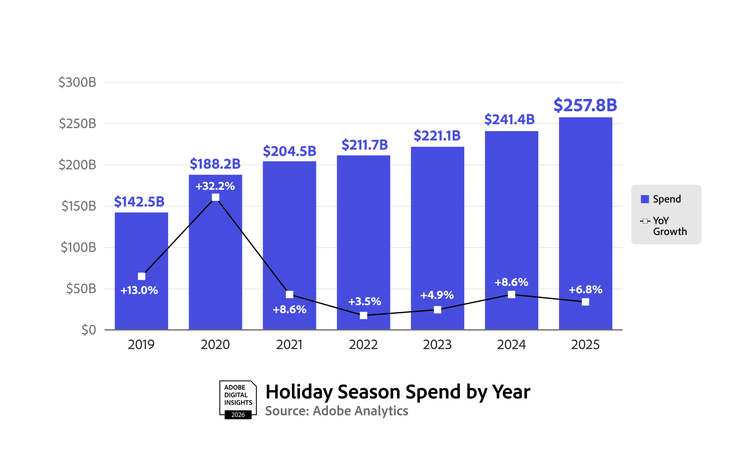
US online shoppers spent a record USD $257.8 billion over the 2025 holiday season, according to new data from Adobe, as consumers increased mobile purchases, leaned on Buy Now Pay Later services and experimented with generative AI tools when searching for deals.
Adobe said spending between November and December rose 6.8% year on year. Consumers spent more than USD $4 billion on each of 25 separate days, up from 18 such days in 2024.
Cyber Week, which spans Thanksgiving through Cyber Monday, delivered USD $44.2 billion in sales. That was up 7.7% on the prior year.
Cyber Monday remained the single largest day for US eCommerce. Shoppers spent USD $14.25 billion, an increase of 7.1% year on year. Black Friday grew faster, with sales of USD $11.8 billion, up 9.1% as retailers pushed earlier promotions. Thanksgiving Day generated USD $6.4 billion, up 5.3% year on year.
Smartphone shift
More than half of online transactions in the period took place on smartphones. Adobe reported that 56.4% of purchases used a mobile device, up from 54.5% in 2024.
Mobile's share peaked on Christmas Day at 66.5% of online sales. That compared with 65% a year earlier. Thanksgiving Day saw a 61.6% mobile share, up from 59.3% in 2024.
Consumers showed different habits when returning items. Adobe said returns were down 1.2% for the season compared with the previous year. In the six days after Christmas, returns rose 4.7%, and one in seven returns in the period took place during that window.
Shoppers used desktops more often for returns than for purchases. Mobile devices accounted for 38.8% of returns, while they generated 56.4% of overall spending.
Heavy discounting
Retailers offered deeper discounts across many categories. Adobe said electronics discounts peaked at 30.9% off listed prices, up from 30.1% in 2024. Toys reached 29.6%, up from 28%. Apparel discounts hit 25.1%, up from 23.2%.
Televisions, computers, sporting goods, appliances and furniture all saw markdowns around or above 20%. Televisions were discounted by 24.3%. Computers saw 23.4% discounts. Sporting goods were at 20.3%. Appliances were at 20.2%. Furniture discounts averaged 18.8%, slightly below the previous year.
Adobe reported a shift towards higher-priced products during the period. The share of units sold for the most expensive items rose 20% compared with the rest of the year. In electronics that figure was up 56%. Sporting goods were up 55%. Appliances increased 38%. Personal care products rose 34%. Tools increased 29%.
BNPL hits milestone
Use of Buy Now Pay Later services reached a new high. Adobe said BNPL purchases contributed USD $20 billion in online spending, a 9.8% rise that added USD $2.8 billion compared with the prior season.
Smartphones dominated BNPL transactions. Mobile devices accounted for 82.2% of these orders.
Cyber Monday became the biggest day on record for the instalment payment format. BNPL-driven purchases reached USD $1.03 billion, up 4.2% year on year.
In a survey of more than 1,000 US consumers, Adobe found respondents were most likely to use BNPL for electronics, apparel, toys and furniture.
Generative AI surge
Generative AI tools featured more in the shopping journey. Adobe reported that traffic to retail sites from AI-powered chat services and browsers rose 693.4% compared with the 2024 holiday period. That measure tracked shoppers who clicked from an AI interface through to a retail website.
On Cyber Monday, AI-driven traffic to US retail sites rose 670%. Use was highest for video games, toys, appliances, electronics and personal care products.
"This 2025 holiday season, consumers embraced generative AI more than ever as a shopping assistant in their purchasing decisions," said Vivek Pandya, lead analyst, Adobe Digital Insights. "Competitive discounts and flexible payment options like Buy Now Pay Later also contributed to driving record spend of $257.8 billion throughout this holiday season."
Category breakdown
Three sectors accounted for more than half of online spending. Electronics generated USD $59.8 billion, up 8.2% year on year. Apparel brought in USD $49 billion, up 7.4%. Furniture contributed USD $31.1 billion, up 6.6%.
Cosmetics saw USD $8.4 billion in sales, up 9.3%. Groceries reached USD $23.7 billion, up 10.2%. Sporting goods brought in USD $8.4 billion, up 7.7%. Toys generated USD $8.8 billion, up 7.8%.
Some products grew much faster than the overall market when measured against pre-season sales in October. Video game sales rose 415%. Hand tools were up 395%. Refrigerators and freezers increased 360%. Home security products rose 360%. Washers and dryers increased 350%.
Headphones and speakers rose 320%. Puzzles and boxed games were up 300%. Fragrance grew 295%. Holiday décor rose 285%. Smartwatches rose 285%. Power tools increased 280%. Earrings rose 275%.
Adobe listed LEGO Icons sets, Wicked dolls, Furreal plush toys, LeapFrog Learning toys, Hot Wheels sets, Fisher Price Little People, Bluey playsets, Nerf guns, Play-Doh sets and DIY craft kits among the season's best-selling toys.
Top gaming hardware included Xbox Series X/S, PlayStation 5, Nintendo Switch 2 and PlayStation Portal. Leading titles included Call of Duty: Black Ops 7, Elden Ring: Nightreign, Pokémon Legends, NBA 2K26 and Donkey Kong Bonanza.
Other strong sellers included mirrorless digital cameras such as the Sony A7IV, Apple Watch Series 11, fragrance sets, luggage sets, cordless vacuum cleaners, Ray-Ban Meta glasses, air fryers, cookware sets and stainless-steel tumblers.
Marketing and fulfilment
Social media delivered a larger share of revenue for retailers. Adobe said social platforms generated 4.6% of online revenue, up 40.3% year on year. That compared with a 3.3% share in 2024, when growth was 5.4%.
Affiliates and partners, which include social media influencers, represented 20.4% of revenue. That share was up 15.9% from 17.6% the previous year.
Adobe said paid search and email remained major marketing channels. Consumers increasingly used social media for product discovery and research.
Curbside pickup featured less often than in 2024 but still played a material role. It accounted for 17.1% of online orders at retailers that offered the service, down from 17.5% the previous year. Usage peaked on 23 December, when it reached 39% of online orders as shoppers sought last-minute gifts.
Adobe plans further analysis of how AI-driven discovery, flexible payments and social commerce influence shopper behaviour in future holiday seasons.