

Miro adds AI agents & integrations for team workspaces
Thu, 21st May 2026 (Yesterday)
Miro has introduced new artificial intelligence tools and integrations for its collaborative workspace, aiming to bring individual AI work into a shared team environment.
The update includes agent-based tools called Sidekicks and Flows, new connectors to third-party software, and native links with ChatGPT, Claude and Microsoft Copilot. Miro also announced additions to its prototyping product, designed to turn existing project context into draft product concepts that teams can review together.
Miro is framing the changes around a problem many businesses face as AI use spreads across organisations. Staff may use AI tools on their own, but those interactions often remain in private chats or separate applications, making it harder for teams to align decisions and maintain a shared record of work.
Under the changes, Miro's canvas can now be read and written by third-party agents. Support now extends across board creation, frames, comments, shapes and code blocks, while agent-friendly formats such as Mermaid diagrams, Markdown and HTML widgets have been added.
This allows software agents to contribute directly to the visual workspace rather than operating outside it. Connectors for services including Slack, Atlassian, Granola and GitHub are intended to move information between Miro and the systems where work is carried out.
The aim is to let decisions and material created inside Miro flow into other tools without manual recreation. Miro can also now act as a native connector inside ChatGPT, Claude and Microsoft Copilot, allowing work produced in those tools to surface on a team canvas.
Agent tools
Sidekicks, previously presented as an AI assistant, is being expanded into what Miro describes as a more autonomous tool that can interpret a user goal, break down a task and ask follow-up questions. It can also generate board content from a single prompt, including documents, diagrams, kanban boards, sticky notes and frames.
Sidekicks will also use persistent context and memory to track what users are working on and resume tasks with the relevant background. A two-way voice chat feature has been added, allowing users to speak to the tool rather than type prompts.
Flows, another part of Miro's AI offering, is being extended beyond the canvas through the same connector system. The aim is to automate repeatable work such as stand-ups, sprint reviews and project kick-offs by pulling in meeting transcripts, creating tasks in project tracking systems and adding approval steps where a person must sign off.
Prototype updates
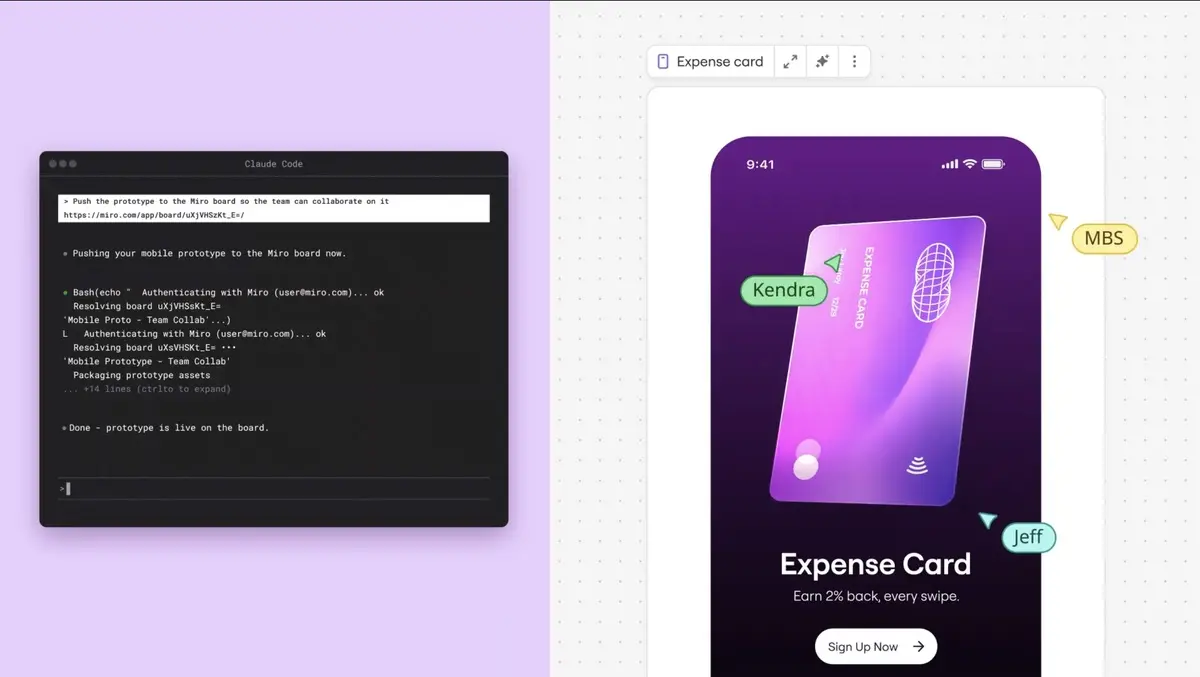
Alongside the agent features, Miro has updated Miro Prototypes, a product aimed at turning ideas and design material into testable prototype options for team discussion. New features include importing context from tools such as Claude Code, generating editable multi-screen flows from screenshots or Figma files, and producing several prototype variants at once.
Users will also be able to apply a brand style to AI-generated prototypes by extracting themes from a URL or selecting from a brand centre. Final prototypes can then be exported to coding agents or Figma while retaining project context.
Andrey Khusid, chief executive officer and founder of Miro, said the wider issue is not simply access to AI tools, but whether organisations can turn individual gains into shared progress.
"AI leverage is locked inside private chat windows - accelerating individuals, but never reaching the organisation," said Khusid. "When every collaboration mode converges on one surface, individual speed becomes company speed, and individual clarity becomes shared clarity. A collection of 10x people pulling in different directions transforms to become a 10x company pulling in the same direction. Every organisation will need to make that shift to stay competitive. That's the outcome we're building toward."
Industry analysts are also watching how workplace software groups adapt to AI use that increasingly stretches across multiple applications and users. For vendors, the issue is no longer just adding an assistant to a product, but deciding where context sits when people and software agents both contribute to a task.
"AI is more powerful when it supports and augments teamwork," said Wayne Kurtzman, research vice president, collaboration and communities, at IDC. "Leaders must seek out the tools and technologies that enhance their teams' creativity, agility, and innovation. As work becomes more agentic, AI's ability to connect to work, alongside teams, becomes critical to tackling bigger challenges."
Miro also included a customer view on the practical challenge of keeping context visible when AI tools are used across an organisation.
"Accelerating work with AI in a silo creates speed without direction - and that's a problem," said Matt Cloke, CTO Endava. "What Miro brought to life for me was the importance of keeping context on the canvas, where everyone can see and build on it. People think about context as static things - documents, images - but everything can be visual context: a sticky note, a table, a workflow, even a pop-up interaction. Having that context accessible and connected is what makes AI powerful. How you parse it through and onwards to other elements of AI - that's where the real value is."