

Google Maps adds AI chat & 3D immersive navigation
Sun, 15th Mar 2026
Google has added a new conversational layer to Google Maps and overhauled its driving experience with 3D visuals and revised guidance. The changes are tied to its Gemini artificial intelligence models and to the scale of its mapping and user-contributed data.
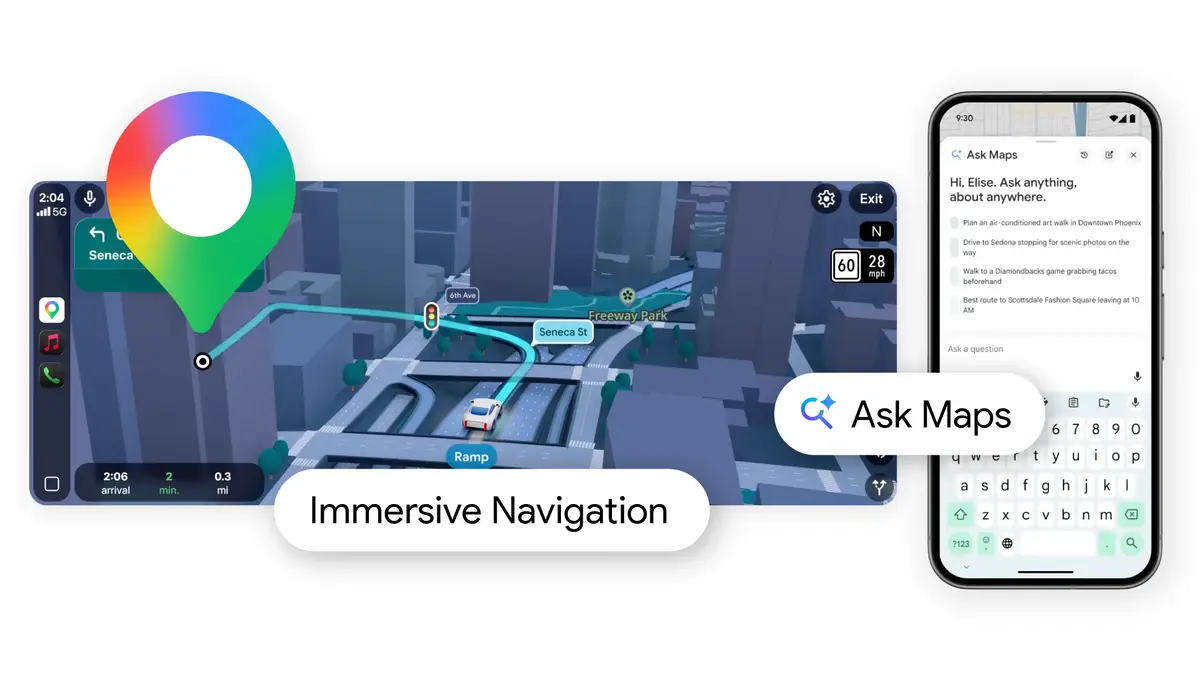
The update focuses on two features. Ask Maps adds a chat-style interface for finding places and making plans. Immersive Navigation redesigns turn-by-turn navigation with a broader route view, clearer road details and updated voice instructions.
Ask Maps
Ask Maps lets users ask complex questions about nearby places without manually searching and reading through reviews. It returns a conversational answer alongside a customised map view showing relevant options.
The tool supports queries that combine constraints and preferences. Examples include finding somewhere to charge a phone without waiting in a coffee queue, or locating a public tennis court with lighting available later in the day. Google says this reduces the need to research multiple listings and review pages.
For trip planning, Ask Maps can handle multi-stop requests. Google gave an example prompt that includes the Grand Canyon, Horseshoe Bend and Coral Dunes, then asks for recommended stops along the way. Responses can include directions and estimated arrival times, plus tips drawn from user contributions and reviews.
Google says the system analyses information from more than 300 million places and draws on reviews and other inputs from a community of more than 500 million contributors.
Personalisation is central to the experience. According to Google, responses can reflect a user's prior behaviour in Maps, such as searches or saved places. In one example, a request for a meeting spot between friends is matched against known dietary preferences and travel logistics from different starting points.
After a user selects a venue, Ask Maps links to common follow-on actions in the app. Users can book restaurant reservations, save venues to lists, share options with friends and start navigation.
Ask Maps is rolling out first in the US and India on Android and iOS, with a desktop version planned.
Immersive Navigation
Google is also revising its driving experience with Immersive Navigation, which it calls its biggest navigation upgrade in more than a decade. It combines redesigned visuals with what it describes as more intuitive guidance.
The interface shifts to a 3D view showing buildings, overpasses and terrain, and can highlight road elements such as lanes, crosswalks, traffic lights and stop signs. Google says this is driven by analysis of Street View imagery and aerial photos.
The update also changes how much of the route is visible while driving. Maps can show more of the road ahead, while smart zoom and transparent building renders reduce visual obstruction and surface upcoming turns and lane changes earlier.
Voice guidance has also been updated. Google says the instructions are designed to sound more natural, like a passenger giving directions. One example of the new style distinguishes between consecutive motorway exits and pairs spoken prompts with prominent on-screen cues.
Routing and disruption alerts have also been adjusted. Google says Maps incorporates more than 5 million traffic updates globally every second. Under Immersive Navigation, the app can surface "tradeoffs" between alternate routes, such as a longer route with less traffic or a faster one that includes tolls.
The system can also flag real-time disruptions such as road construction and crashes. Google says these alerts are informed by driver contributions, citing more than 10 million contributions per day.
Immersive Navigation puts more emphasis on arrival details. Users can preview the destination area in Street View before starting a drive and see suggested parking. As drivers approach, Maps can highlight the entrance, nearby parking and the side of the street.
Immersive Navigation begins rolling out across the US and will expand over the coming months. Google says it will be available on eligible iOS and Android devices and will extend to CarPlay, Android Auto and vehicles with Google built-in.
The new features reflect a broader shift in how Maps presents information, moving from lists and pins to guided answers and proactive driving cues. "Combining our Gemini models with our deep understanding of the world unlocks entirely new possibilities for how you navigate your daily life and discover new places - we can't wait to see where it takes you," said Miriam Daniel, VP & GM, Google Maps.